By Tom Tracy - Florida Catholic
MIAMI | In early 2024, Florida residents watching local TV news learned that a bishop in Haiti had been airlifted to a local hospital, where he would be treated for serious burns following a fiery explosion near the Haitian capital.
Bishop Pierre-André Dumas, who oversaw the Diocese of Anse-à-Veau-Miragoâne, Haiti, and who was vice president of the Haitian Bishops’ Conference, had been an outspoken critic of the political and social chaos enveloping his nation; it remains unclear what exactly precipitated the explosion, which left him with serious burns on his face, arms, and legs.
The bishop arrived at Miami’s Jackson Memorial Hospital for burn-related treatment and has remained in the Miami region for the past two years, with the support and friendship of the local Haitian-American community and the Archdiocese of Miami.
“As a pastor, as a witness, as a sentinel, as a victim myself of what appears to be selective or collective violence, my life has passed through fire, explosion, and more than 40% of my body has suffered third-degree burns,” Bishop Dumas said, noting the multiple surgeries, laser treatments, intensive therapies, and bodily and spiritual healing he has undergone in Miami.

Photographer: ANDONI BIURRARENA| FC
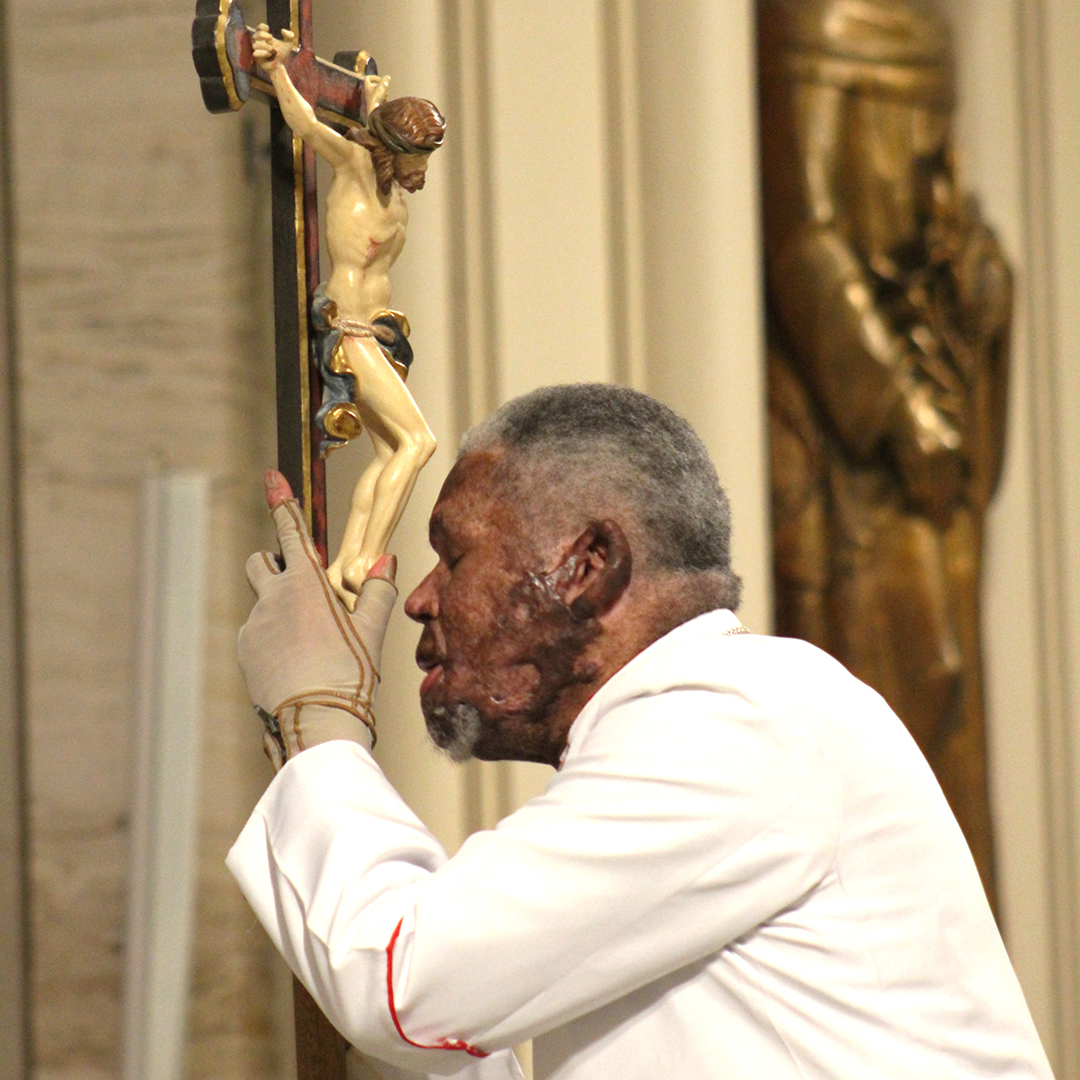
Bishop Pierre-André Dumas during Palm Sunday Mass at St. Mary Cathedral, March 29, 2026.
A bishop marked by violence, now healing in Miami
Before the incident, Bishop Dumas had been active in working with civil and government authorities in Haiti to address the political crisis gripping the nation and a kidnapping epidemic attributed to gangs that have become emboldened amid the chaos following the 2021 assassination of President Jovenel Moïse.
A month before the fire, he had reportedly offered himself in place of a group of six nuns who were kidnapped in his diocese in January 2024.
His face still bearing the scars of the fire, Bishop Dumas is often seen concelebrating Mass with Archbishop Thomas Wenski at large celebrations such as the annual priestly ordinations.
In addition to regular medical treatments over the past two years, he has taken remote learning courses through The Catholic University of America and has had time to process the events of the past several years.
His new life in the United States, and South Florida in particular, has afforded him moments of peace and prayerfulness, both through visits to the ocean and in nature, and during time spent at Miami’s St. Mary’s Cathedral, Gesu Catholic Church downtown, and the Notre Dame d’Haïti Mission in Miami
.“I have been blessed with many friendships: my clergy brothers, lay leaders, and faithful members of the Haitian diaspora,” Bishop Dumas told The Florida Catholic. “Some have become true companions on this journey. Friendship, in times of suffering, is not a luxury — it is a form of grace.”
“After so much suffering, these have been for me signs of God’s tenderness,” he added.
Haiti, like much of the rest of the world, Bishop Dumas said, is living through not only a time of change but “a change of era, a turning point in history that is shaking the foundations of humanity,” with forces that spread violence, fear, chaos, and despair, while also revealing a people who refuse to disappear in the face of violence.

Photographer: ANDONI BIURRARENA| FC
Bishop Pierre-André Dumas during Palm Sunday Mass at St. Mary Cathedral, March 29, 2026.
Haiti’s descent into violence after Moïse’s assassination
Since the 2021 assassination of President Jovenel Moïse, Haiti has descended into a deepening spiral of violence and institutional collapse, as armed gangs have exploited the resulting power vacuum to expand their control.
Today, gangs dominate roughly 80% of Port-au-Prince, fueling a humanitarian crisis marked by killings, kidnappings, and mass displacement.In 2024 alone, more than 5,600 people were killed in gang-related violence, while kidnappings, sexual violence, and coordinated attacks on entire communities have become widespread, , according to United Nations data.
More than 1.4 million Haitians have been forced from their homes, and over 5 million — nearly half the population — now require humanitarian assistance.
Haitian disorder is due to a spiritual crisis, but also to inequalities and extreme poverty, the proliferation of arms and organized gangs, and a collapse of trust in leadership, justice, and the future, Bishop Dumas said.
“At the root of the crisis lies a state that has become fragile — and at times, captured. Institutions that should protect the common good have too often been weakened, politicized, or paralyzed,” he said.
“The absence of a strong, credible, and trusted public authority has created a vacuum — and violence always rushes to fill it.”
Entire generations have grown up without access to quality education, dignified work, and basic services, he noted. Where hope disappears, violence fills the void.
For Bishop Dumas, confronting that reality requires moral clarity: “If we truly want to confront the violence in Haiti, we must begin with courage — the courage to name its roots.”
Faith, leadership, and a mission beyond suffering
Turning to his time spent in the U.S., Bishop Dumas noted his studies with the Busch School of Business at The Catholic University of America in the nation’s capital. Specifically, he enrolled in a church management program there.
The program helped him see that pastoral ministry today requires spiritual depth but also strategic leadership, transparency, and accountability.
“I have learned to integrate mission with management, faith with sustainability, and vision with structure. The formation strengthens my desire to build a church that is both prophetic and well-governed,” Bishop Dumas explained.
Until he makes a decision about when he can return to his home diocese, Bishop Dumas has found a welcoming atmosphere in Florida, where he credited Archbishop Wenski for receiving him as “a friend and brother in Christ.”
“This man showed me his compassion, his kindness, his fraternal love, and his commitment to all vulnerable strangers, above all to crucified Haitian nationals who live here with Temporary Protected Status (TPS). I received a very powerful and authentic testimony of fraternal integration in the community of Miami,” Bishop Dumas said.
In addition, the entire body of clergy, religious, and faithful in South Florida has surrounded him with prayer and kindness, he said.
It's also been a time for the bishop to witness a generation of young Haitian expatriates who, he said, are rising — not from comfort, but from struggle — to show the world the true face of Haiti as resilient, intelligent, and full of hope.
“They are motivated and committed to the future of their country; I have met Haitian communities in Florida, New York, New Jersey, and Boston,” the bishop said. “What I see is remarkable resilience and creativity.”

Photographer: ANDONI BIURRARENA| FC
Bishop Pierre-André Dumas during Palm Sunday Mass at St. Mary Cathedral, March 29, 2026.
Migration, dignity, and a moral test for the world
As the U.S. legal system continues to grapple with the legal issues surrounding immigrants from Haiti and the TPS program, Bishop Dumas hopes young Haitians being formed here will one day be in a position to return to their country as agents of transformation.
“The issue of Haitian migration, especially TPS, is deeply human and moral.
We are speaking about hundreds of thousands of lives, families, and futures,” Bishop Dumas added. “To abruptly remove protection from people fleeing chaos would not only be a political decision — it would be a moral failure.”
As he reflects on his ability to summon resilience in extreme difficulty, Bishop Dumas turns to the role of his parents: “My parents gave me something that no violence can destroy: faith, education, honor and respect, eternal and traditional values, profound virtues, ecclesial principles, as well as order, discipline, integrity, love of truth, and resilience.”
“In my suffering, I returned to that foundation. Their love became a memory that sustained me — a quiet strength that whispered, ‘Stand. Do not give up.’”